

Categories

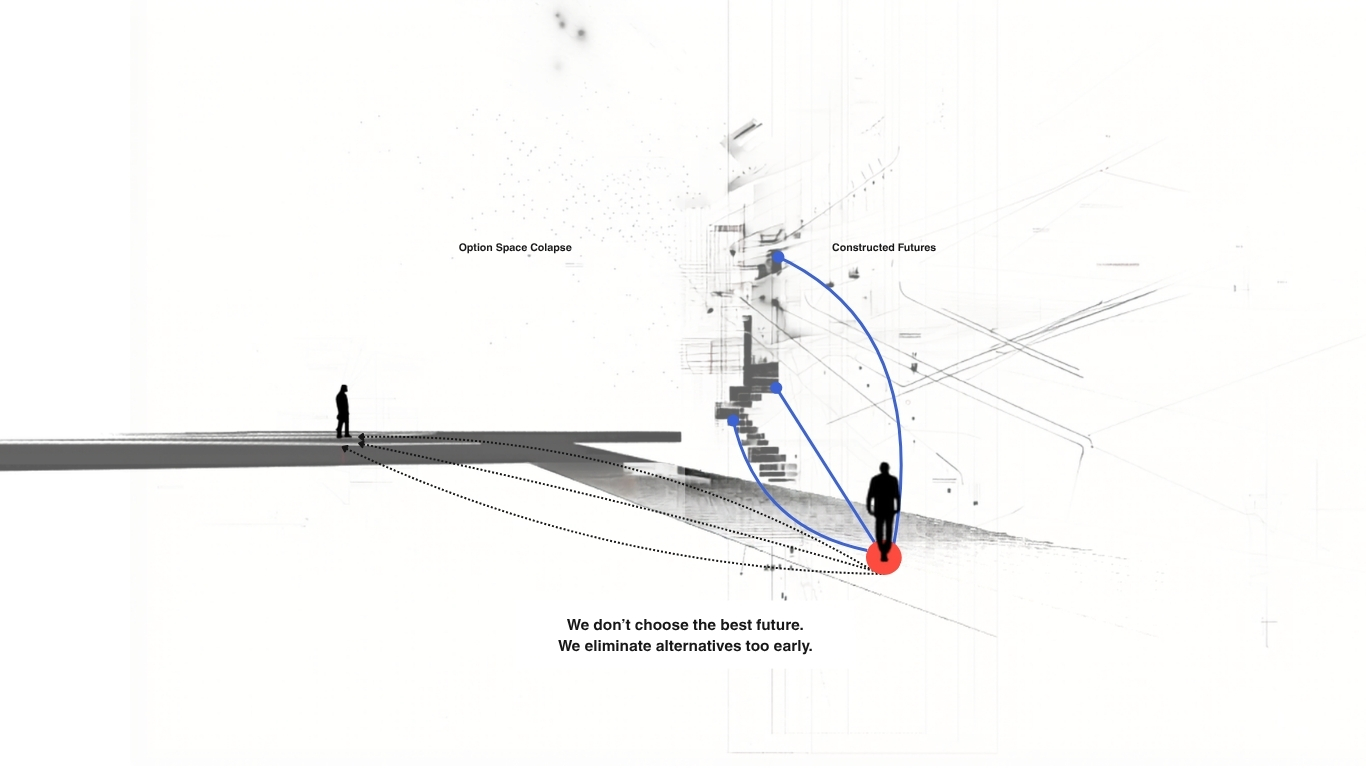
After a period of exploration around AI tools, workflows, and capabilities, this series of posts shaping an architectural intelligence map, returns with a different focus. Not on tools, but on thinking, and more specifically on how architectural thinking evolves when it is placed inside systems that demand decisions rather than representations. Each post will function as a small unit of knowledge within a larger trajectory.
The underlying question is simple:
how does an architect evolve into an urban decision architect?
This post is where that trajectory begins.
What exactly is missing in architectural thinking?
Architecture operates on a powerful assumption: that a deep understanding of space will naturally lead to the right decisions. The discipline has refined this capability for decades, developing increasingly sophisticated ways to read context, interpret constraints, and synthesize complex conditions into form.
But this assumption no longer holds.
Spatial reasoning, as it is currently practiced, does not produce decisions. It produces representations. Plans, models, and simulations describe possible states of a system, but they do not resolve which state should be pursued. The gap between understanding and deciding remains largely unstructured.
Why does this become a problem at the scale of the city?
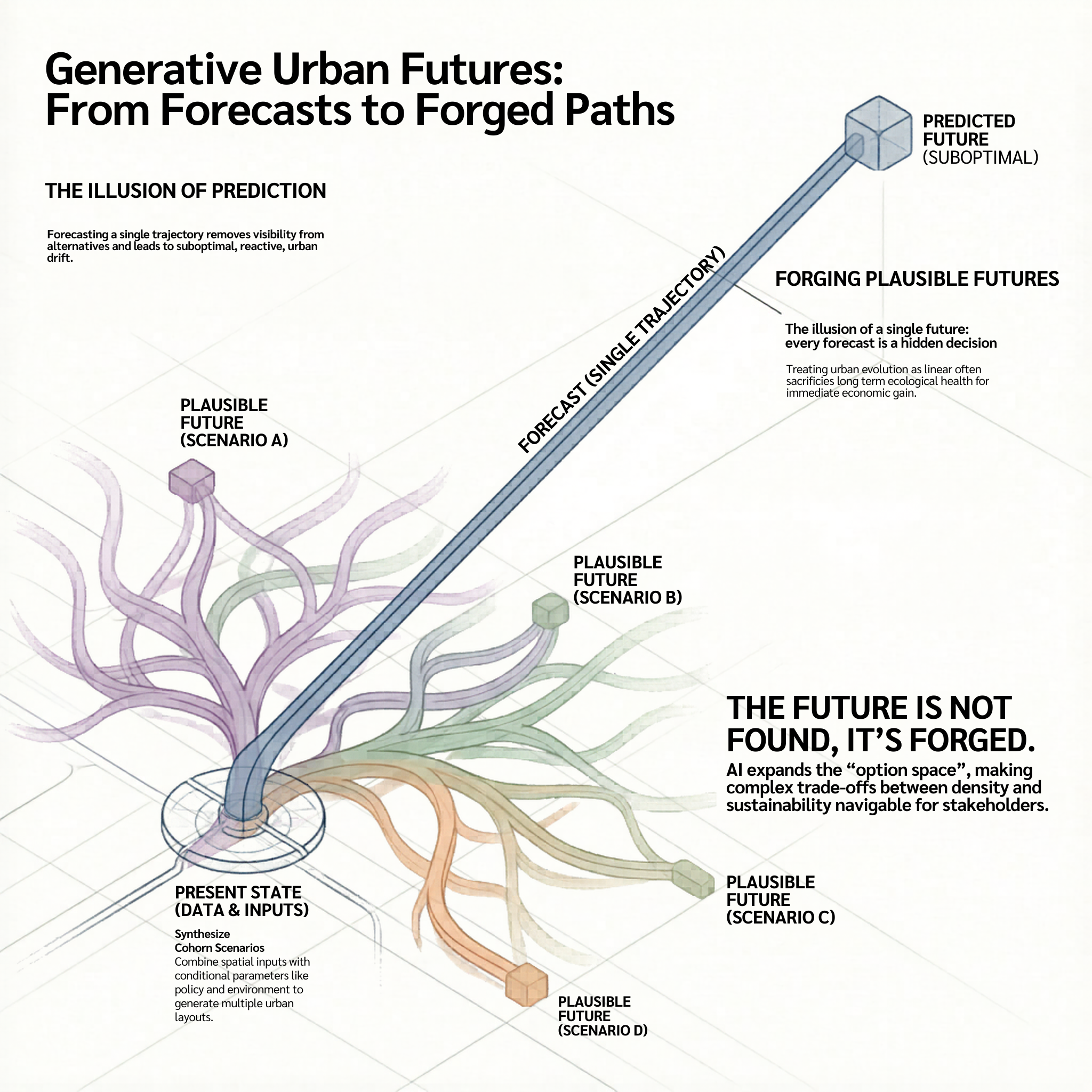
Cities are typically approached through predictive models. Growth is forecasted, density is projected, and infrastructure is planned against anticipated demand, as if there is a correct trajectory embedded within the data waiting to be uncovered.
There isn’t.
Urban systems do not evolve along a single path. They unfold through competing forces—economic, environmental, political—each pushing toward different outcomes. What is often presented as “the future” is, in reality, one selection among many plausible alternatives.
Prediction, in this context, is not neutral. It is a hidden decision. By presenting one trajectory as the expected outcome, it removes visibility from the alternatives that were never explored and compresses a field of possibilities into a single narrative.
This is the structural failure.
What changes when we stop predicting and start constructing futures?
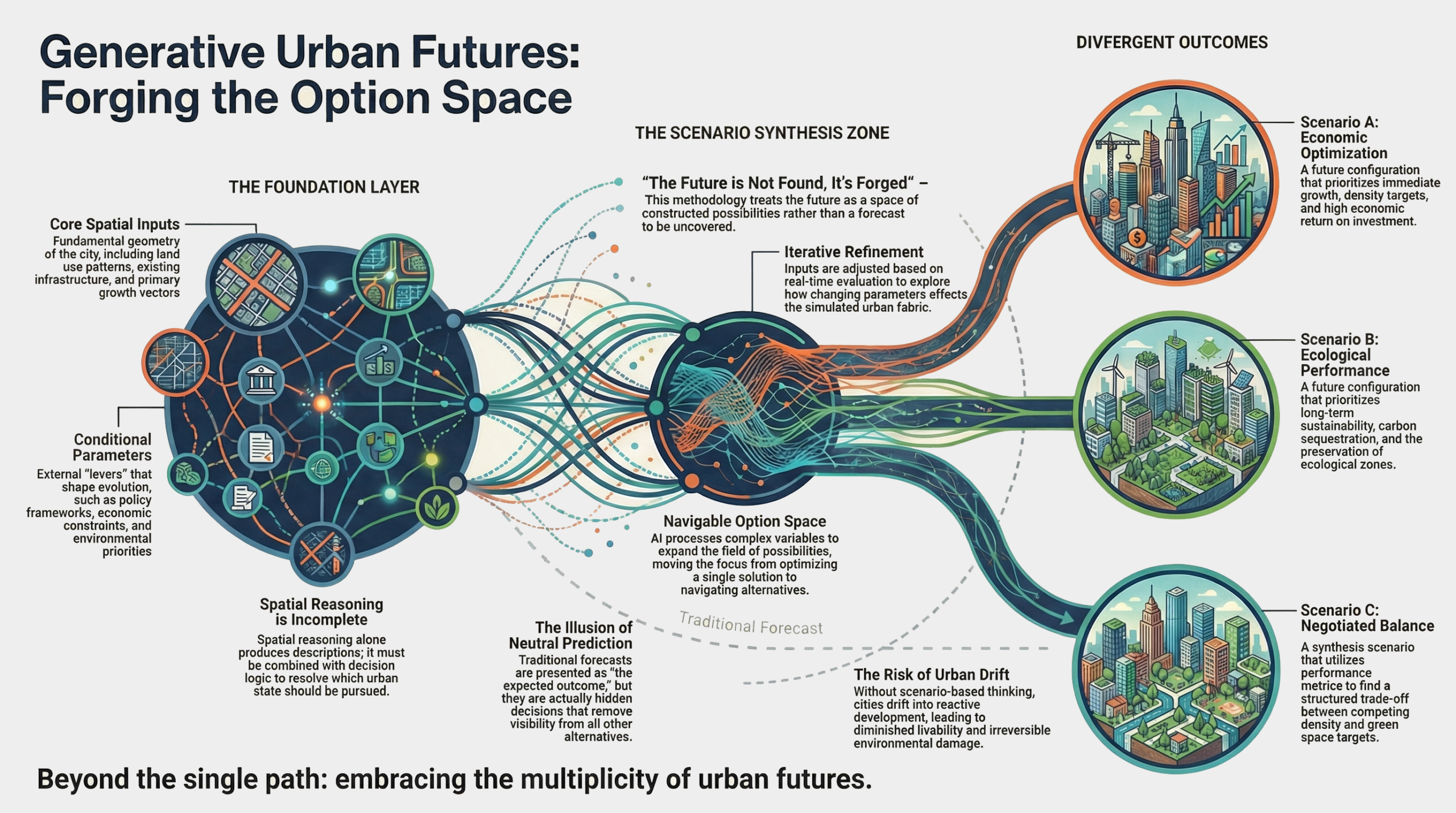
A different model emerges when the future is treated not as a forecast, but as a space of possibilities. Instead of asking what will happen, the process begins to explore what could happen under different conditions.
This introduces a new structure.
It begins with spatial inputs—geometry, land use, infrastructure, environmental conditions—which define the current state of the system. On top of this, parameters are introduced: policy choices, economic constraints, environmental priorities. These parameters shape how the system can evolve.
From this foundation, multiple scenarios are generated. Each scenario represents a coherent future, not a variation of a single idea but a distinct configuration of trade-offs. Evaluation then follows, using performance metrics and explicit weighting of priorities to understand the implications of each alternative.
The decision is no longer embedded within a drawing. It emerges from the comparison between alternatives.
What does this look like in practice?
Consider a single urban block. A conventional process leads to a proposal that maximizes allowable density, followed by adjustments to address environmental or social concerns. The outcome is a refined design that attempts to balance competing requirements within one scheme.
A scenario-based approach produces multiple futures from the outset. One scenario prioritizes density and economic return. Another preserves ecological performance. A third balances both at the cost of optimization.
Each scenario is valid. Each is internally consistent. The difference lies in what is being prioritized and what is being sacrificed.
The question shifts from design quality to decision logic.
Where does the current workflow break?
Architecture is not structured to compare scenarios, evaluate conflicting objectives, or make explicit trade-offs. Analysis leads directly to design, and the decision layer remains implicit. At smaller scales this can be absorbed by experience and intuition, but at the scale of urban systems it leads to reactive trajectories and long-term consequences that are rarely fully evaluated.
This is not a failure of design. It is a failure of structure.
What does AI actually enable?
AI does not simply accelerate representation. It enables a different class of operations: processing complex variables, generating multiple coherent scenarios, and supporting structured comparison across competing objectives.
In doing so, it expands the option space and makes it navigable.
Spatial reasoning does not disappear. It becomes the input layer of a larger system that includes scenario generation, evaluation, and decision logic as explicit components.
So what is the real shift?
The role of architecture moves from producing form to structuring decisions about form. Value shifts from optimizing a single solution to understanding and navigating a field of alternatives.
For developers, this means delaying premature convergence in favor of scenario awareness. For cities, it replaces the idea of a predicted future with a negotiated one.
If each post is treated as a knowledge atom, then over time these atoms form a system. Not a collection of insights, but a structured methodology for decision-making in spatial systems.
Spatial reasoning is not obsolete. It is incomplete.
The future of architecture will not be defined by better representations of space, but by the systems that translate those representations into decisions.
If you want to be the first to receive the next knowledge atom of architecture intelligence map, sign up to our newsletter.
- Tags:
- AI in Architecture
Comments are closed.